Home/Partridge shooting in West Berkshire: A driven day at Compton Beauchamp
Shooting
Partridge shooting in West Berkshire: A driven day at Compton Beauchamp
Ben Palfreyman experiences a memorable partridge shoot at Compton Beauchamp, where heritage, hospitality and sporting excellence combine in the heart of West Berkshire
Sporting Gun7 April 2026
Driven partridge shooting at Compton Beauchamp estate
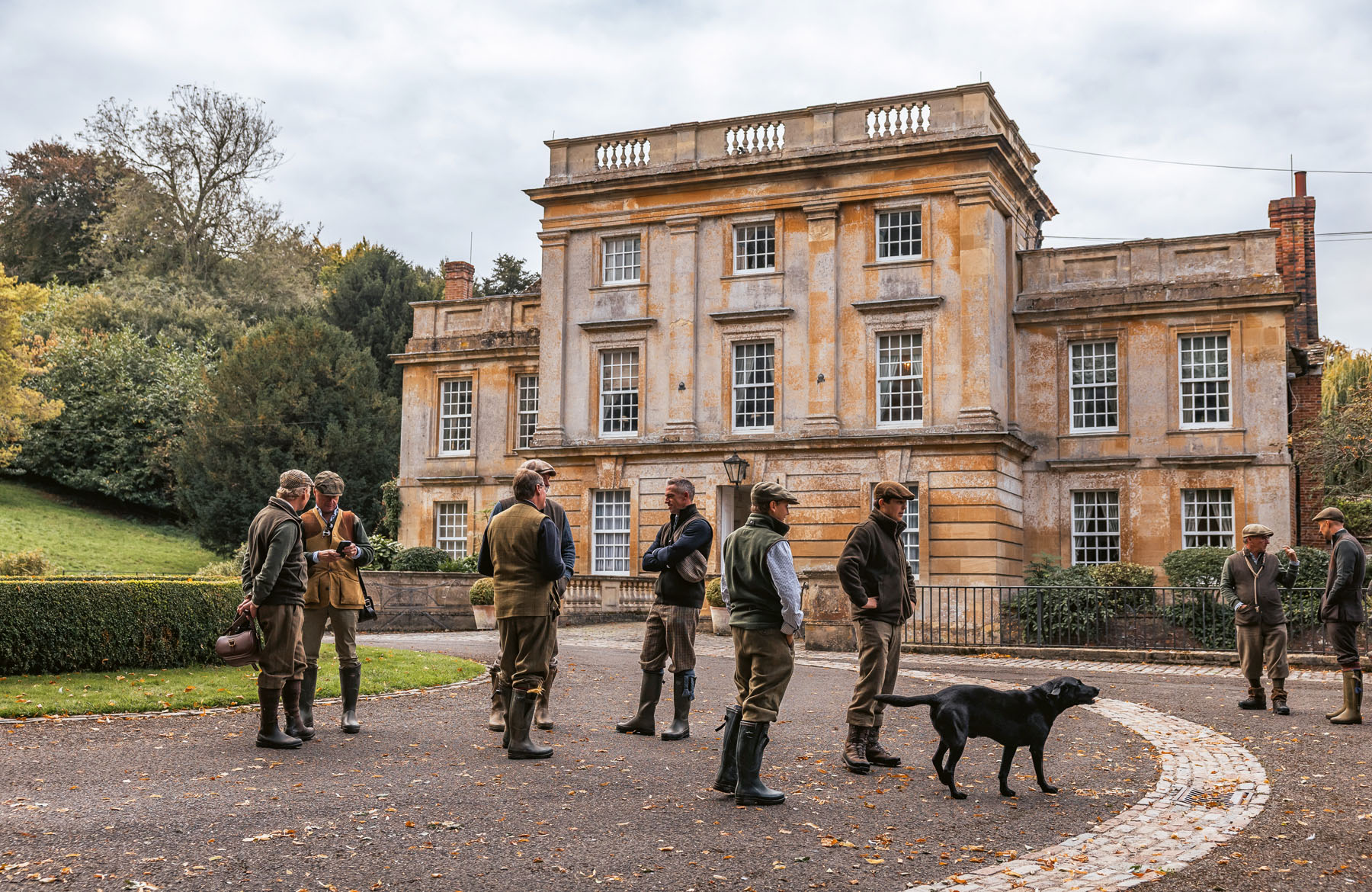
Look up as you turn into the circular gravelled drive in front of Compton Beauchamp House and you will notice two initials intertwined on the ornate wrought-iron gates. They are the romantic flourish of Edward Richards, who on marrying Rachel Warneford in 1710 decided to impress his new wife by erecting the current fashionable Palladian facade on the front entrance of this Tudor manor house.
Now home to Jimmy and Sofia Watson, Compton Beauchamp has an undeniably romantic feel, with its grassy moat, 13th century village church and thatched barns – one of which Jimmy renovated to host a birthday party for Sofia and now offers the perfect spot for elevenses.
West Berkshire shooting: heritage and landscape
The estate lies in the Vale of the White Horse, just a few miles from the Bronze-age Uffington White Horse, the oldest of all the chalk figures that lie along England’s southern counties. This long chalk ridge is characterised by big skies, sweeping open farmland and a deep-rooted fieldsports tradition that has shaped the landscape for centuries.
In the late 1500s, when the current manor at Compton Beauchamp was built, this part of west Berkshire was Craven country: a constellation of great houses linked to the remarkable story of Elizabeth Stuart, known as the ‘Winter Queen’. Daughter of King James I, she was crowned Queen of Bohemia for a single winter before being driven out of Prague in the snows of 1620. Her escape through ice and drifts became legend, and in her exile she met a young William Craven, one of England’s wealthiest men.
Upon arriving back in England, the unmarried Craven, knowing her love for hunting and the countryside, poured his fortune into building houses for her, including Ashdown House and a rural palace in nearby Hampstead Marshall. She died before either were completed, but in the subsequent centuries, these estates along with Compton Beauchamp formed a network of three hunting lodges used by many successive generations of the Craven family.
Fast-forward to the 1970s, and the estate was bought by Sofia’s parents, Erik and Lillemor Penser. A keen shot, Erik gradually built up the working estate to what it is today, combining arable farming, wild bird conservation and a successful family shoot. It is here that I arrived for a family partridge day, the sort of gathering where the idyllic setting feels as much a host as the people who welcome you at the door.
A family partridge shoot experience
I don’t know what they put in the morning coffee here at Compton Beauchamp, but within seconds of leaving the quiet, charming formality of the house’s front steps, the Gunbus was filled with noise and laughter. As a newcomer to the group, I had clearly arrived the morning after quite a day, as the team swapped stories of late-night darts contests and yesterday’s shooting. I joined a Gun line made up of family – which included Jimmy’s sons, Axel and Louis – and friends.
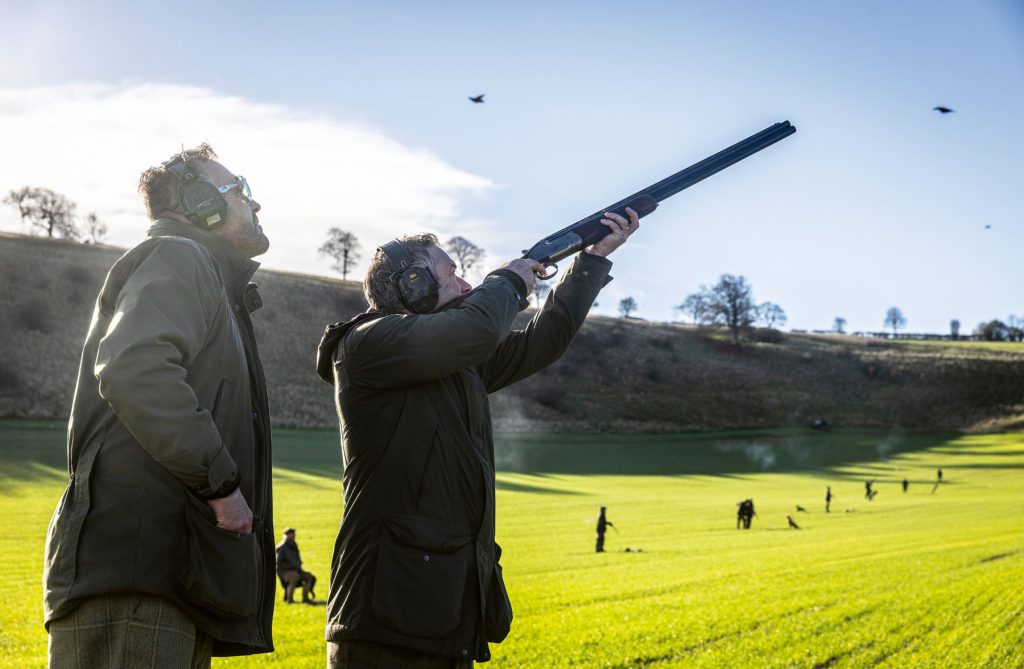
Our first drive was Star Wars, a long hidden valley as dramatic as its name suggests. The banks in front of where the Guns were pegged were far steeper than one would expect in this part of the world. Though the flurries of coveys heading straight over the banks were not extreme, they would rival those of many a top partridge shoot around the UK.
The morning started to brighten, but with almost no wind. Early-season partridges can be a little green on their second or third flight but these lifted strongly, fanning across the line in fast arcs. There is something joyful about a first drive going well: Guns settling in, dogs watching intently, the air gradually filling with the crack of shots. By the time the horn sounded, the Guns were buoyant.
Top partridge drives in West Berkshire
Next came Blowing Stone Hill, a drive that takes its name from the nearby Blowing Stone, a perforated boulder that, according to local legend, was used by Alfred the Great to rally his troops before the Battle of Ashdown in 871. Its call is said to carry across to the White Horse itself. Ring-necks rose over the ridge in great numbers and surprising height, and the line showed great restraint on this pre-season September day and stood easy. The pegs are in a horseshoe shape around a low bank of undergrowth, which creates a lovely feel.
From there it was off to elevenses, which had been set up in the aforementioned beautiful thatched barn that sits at the heart of the estate. Guests swapped tips on the best fly-fishing spots and plans were made for future forays in the field. A more welcoming bunch one could not wish for, particularly the full-time headkeeper Dan McSharry, whose incessant broad grin really set the tone for the day.
Dan’s connection with the estate goes back to his 20s, when he would come beating. “My father was a keeper on the neighbouring estate when I was a young lad. Every day of the week, when I’m up on top of the hill here, I look over and remember that’s where I started out with my dad.”
Later, he followed his father’s footsteps into gamekeeping and in 2017 won a GWCT award for grey partridge conservation while head keeper at the nearby Buckland Estate. “Some of the award-winning land is actually part of Compton Beauchamp,” Dan remembered “and we still have grey partridges down there to this day.”
After a reinforcing elevenses we headed to Beeches, a drive that lies along a grassed flank where coveys of partridge are pushed around a block of beech trees, rising and sliding back in front of the trees and across the slopes in sweeping lines.
The drive offers a breathtakingly beautiful spectacle, the sunshine bouncing off the swathes of birds as they passed back in front of the trees, and the energy imparting a noticeable lift in spirits to the assembled Guns.
Game shooting and estate management at Compton Beauchamp
The journey to the next drive couldn’t have been simpler for the Guns, who simply had to turn to face the line of the trees on the opposite slope. The same could not quite be said for the hardworking beaters and dogs, who had to hotfoot across the valley. The actual shooting of the drive they call Lower Coombes was a different matter. “I love the way the birds rise over the top of the hedges of this drive and starburst over the line,” Dan enthused. “These smaller, more intimate days are what our guests and I are after nowadays: wilder and a bit rougher than they would have been a few decades ago.”
Last came Ashbury Hill, a very tight, steep little gully that becomes a stage the moment the first partridge crests the skyline, at speed. Dan considers it one of the best drives he has developed on the estate, and it’s easy to see why. The birds appear suddenly for just a wink before disappearing. “It’s like snapshooting in a wood,” Dan grins, “but with hills instead of trees. And you literally have seconds to connect.”
Conservation and the future of partridge shooting
Lunch was taken in the shoot dining room, a beautifully renovated space in one of the old cart houses beside the main house. Sofia’s father is a venerable collector, and the walls are adorned with hunting mementoes and impressive antlers of deer he has hunted over the years across Europe. The shoot has a wonderful blend of British and continental sporting heritage that feels entirely natural.
For Dan, the pride is in the conservation of wild birds: the tagging, the planting of wild bird mix margins, the constant labour of vermin control, the expansion of hedgerow networks, the maintenance of the ditches and all the little things that wild partridge and other species need to thrive.
“You’ve got to keep on top of it all year,” he said. “People think keepers stop when shooting ends, but that’s nonsense. It only gets busier for myself and Jaden, Paddy and my father Mike, who all work on the shoot with me.”
This work includes bringing in coveys of different strains of wild Englishmen to maintain the health of the population. Since Dan started tagging, he has realised that, at about 300 birds, the wild population is actually greater than they release, and after careful monitoring decided this year to put on their first wild partridge day. This is hugely encouraging news and a testament to the work Dan has put in over the years.
Compton Beauchamp today is a modern, hardworking estate that can stand proud on the shoulders of the landscape’s shooting heritage, home as it is to a rare assemblage of grey partridge, redleg and pheasant drives that make a wonderful shoot. Jimmy’s enthusiasm for fieldsports ensures that traditions live on here; not only do they shoot game and stalk roe and fallow on the estate, but the local hunt is also encouraged to move through 15 to 20 times a year, with Jimmy (who doesn’t ride) keeping company on an electric motorbike. In a world where Britain’s rural landscapes are changing fast, Compton Beauchamp feels enduring in the best sense.
Information
Around 15 game days are let at Compton Beauchamp and are competitively priced. Simulated game days can also be arranged during the summer months for up to 18 Guns. Contact Daniel Crawford: 01367820650, dcrawford@cb-estates.co.uk
This article contains affiliate links. If you click on one of these links and make a purchase, we may earn a small commission at no additional cost to you. Affiliate income helps us maintain the quality of our content and keep it freely accessible.
All recommendations are based on our honest opinions and thorough research.Would you like to appear on our site? We offer sponsored articles and advertising to put you in front of our readers.
Find out more
Matt Kidd joins Olympic gold medallist Nathan Hales to discover the skills, technique and mental focus required for the holy grail of Trap shooting disciplines
Richard Faulks joins renowned shot and coach John Lee at the Worlaby Shoot to discover how his calm guidance, sharp eye and practical fieldcraft help experienced Guns get the very best from their shoo...
Geoff Garrod reflects on a difficult pigeon shooting winter, the challenges of low bird numbers, and a rewarding late roost shooting outing that offers hope for the months ahead
Jasper Fellows visits West Kent Shooting School, which stands as one of the UK’s most enduring clay shooting venues. What began in 1974 as a modest setup on a disused RAF airfield has evolved into ...
By Sporting Gun
Get the latest news delivered direct to your door
Subscribe to Sporting Gun
Sporting Gun has been the trusted voice of the shooting community since 1978, and a subscription is the best way to make sure you never miss a word of it.
For just £4.99 an issue – 37% less than the newsstand price – you’ll receive Britain’s leading shooting magazine delivered to your door before it hits the shelves. Every issue is packed with expert gundog training advice, in-depth shotgun and cartridge reviews, technique features from professional shots, pigeon and wildfowling coverage and the people and stories that define the sport.
In a world of endless scrolling, a magazine is something different – a moment to slow down, read properly and absorb knowledge that makes you a better shot. Back issues become a reference library worth keeping.
To provide the best experiences, we use technologies like cookies to store and/or access device information. Consenting to these technologies will allow us to process data such as browsing behavior or unique IDs on this site. Not consenting or withdrawing consent, may adversely affect certain features and functions.
Functional
Always active
The technical storage or access is strictly necessary for the legitimate purpose of enabling the use of a specific service explicitly requested by the subscriber or user, or for the sole purpose of carrying out the transmission of a communication over an electronic communications network.
Preferences
The technical storage or access is necessary for the legitimate purpose of storing preferences that are not requested by the subscriber or user.
Statistics
The technical storage or access that is used exclusively for statistical purposes.The technical storage or access that is used exclusively for anonymous statistical purposes. Without a subpoena, voluntary compliance on the part of your Internet Service Provider, or additional records from a third party, information stored or retrieved for this purpose alone cannot usually be used to identify you.
Marketing
The technical storage or access is required to create user profiles to send advertising, or to track the user on a website or across several websites for similar marketing purposes.