★ Win a HÄRKILA Kenmore shooting waistcoat worth £299.99! Click here to enter ★

Beyond steel: could Blue Shot cartridges be the future for classic guns?
Matt Kidd heads to Cornwall to test RC HP3 Blue Shot cartridges on farm corvids, exploring whether this bismuth-based lead-free option could make the transition away from lead easier for owners of older guns and smaller bores.

Following Matt Simpson’s earlier feature, Beyond Lead, which examined the implications of the lead shot transition for those of us shooting older guns without a Fleur de Lys high-performance steel proof mark, cartridge choice has been very much on my mind.
For many shooters using older guns that meet post-1954 proof standards and choke requirements but lack high-performance steel proofing, standard steel has been the most affordable lead-free option without requiring expensive gunsmithing or reproofing. In my own experience, standard steel loads have performed perfectly well for game shooting through my guns.
However, following publication of Matt’s article, Nick Levett-Scrivener, director of Shooting Star, pointed out a relatively new alternative that had been largely overlooked and could make a significant impact in the UK market: Blue Shot.
Manufactured in Europe from a blend of non-toxic metals including bismuth, aluminium, tin and zinc, Blue Shot is designed to mimic many of the malleable properties of lead. It is safe for traditional chokes and, being denser than steel, offers improved retained energy and stopping power. In theory, it provides an affordable lead-free solution for owners of classic guns and smaller bores, provided production can keep pace with demand.
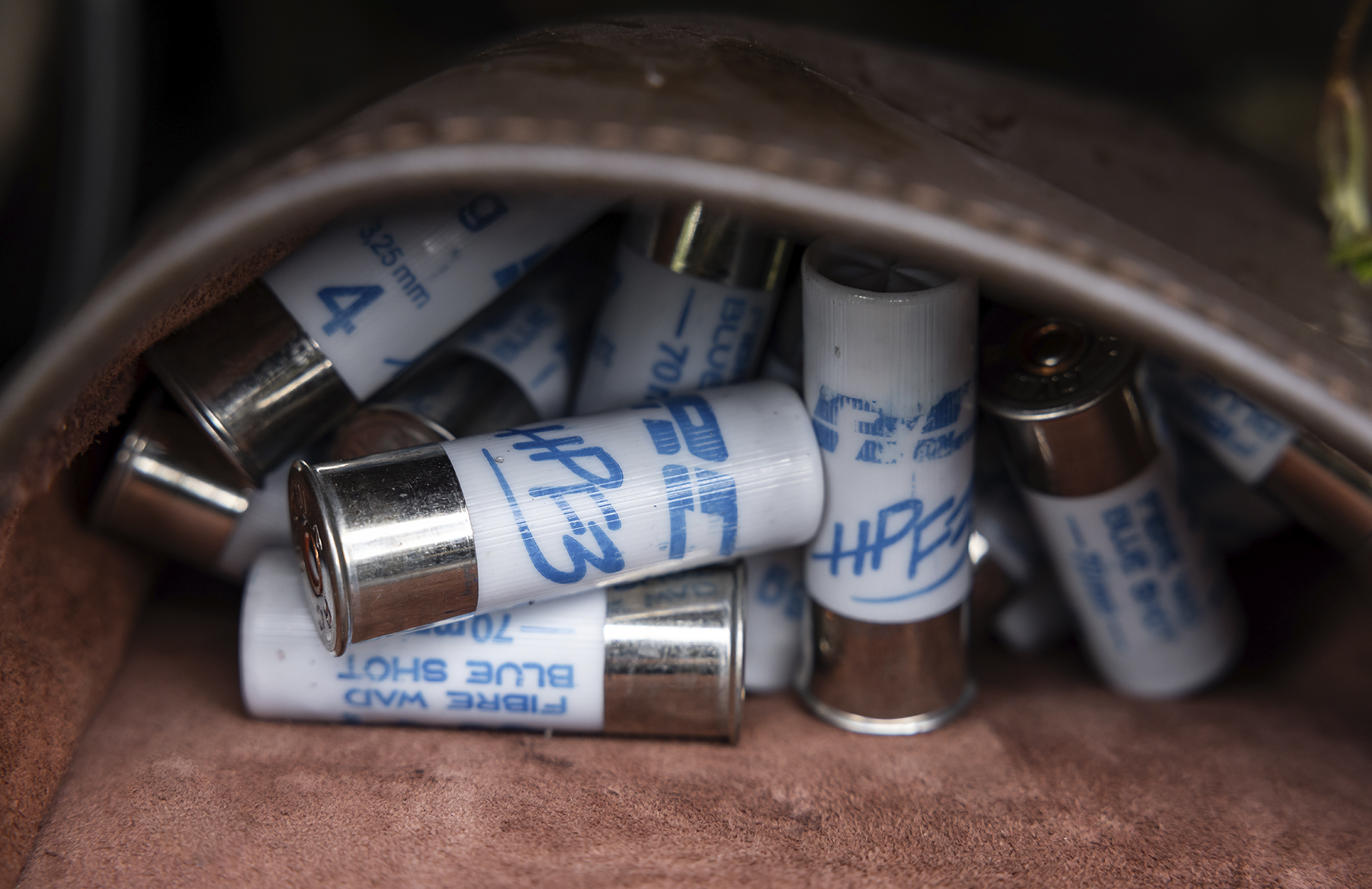
I was already familiar with BioAmmo Blue, a Spanish-made cartridge also imported by Shooting Star, but Nick has invested considerable time researching the technology and helping develop a new loading from one of Britain’s most respected game cartridge manufacturers: RC. With that in mind, I collected a selection of the new RC HP3 Blue cartridges during a visit to Nuthampstead Shooting School this spring.
Understanding the numbers
When collecting the cartridges, I spoke with Ed Barker, who runs Nuthampstead. Ed switched entirely to lead-free ammunition around seven seasons ago and offered a useful perspective on where many shooters go wrong.
We discussed how opinions of lead alternatives were often formed years ago, based on early products that genuinely underperformed, and how much the technology has improved since. Ed argued that, used correctly, modern lead-free loads can actually offer several advantages for game shooting – and that poor results are often down to a misunderstanding of shot size and payload comparisons.
I had experienced this myself. In the past I had avoided certain BioAmmo loads because I assumed a 25g No. 4 steel cartridge would contain too few pellets and lack sufficient killing power. The reality is more nuanced.
If you traditionally shoot a 32g No. 6 lead load, for example, an equivalent steel cartridge would generally be a 24–25g No. 4. The larger pellet size compensates for steel’s lower density, while the reduced payload often still contains around 30% more pellets than the original lead load – and too many pellets can actually harm pattern quality, particularly in older barrels, forcing cones and chokes.
Blue Shot sits somewhere between steel and lead. A 28g No. 4 Blue Shot load offers roughly the same overall payload performance as a traditional 32g No. 6 lead cartridge, because the alloy is only around 20% lighter than lead. It would help if cartridge manufacturers printed equivalent lead-load comparisons directly on the box – it would make the transition considerably easier for a lot of shooters.
Speed isn’t everything
There has been a noticeable trend towards ever-faster cartridges in recent years. Manufacturers are keen to produce them and shooters are often drawn in by the marketing claims, but lead-free shot does not necessarily benefit from excessive velocity.
While higher muzzle velocity sounds appealing, air resistance increases dramatically as speed rises. Lightweight, lower-density materials such as steel lose velocity very quickly once they encounter atmospheric drag. Ultra-fast loads often surrender their initial speed advantage surprisingly quickly, and in many cases a balanced cartridge offering sensible velocity and good pattern density performs better than one chasing headline figures. My expectation is that excessive speed often brings increased recoil with little practical benefit.
What matters, ultimately, is a cartridge that maintains sufficient energy and pattern quality to cleanly kill game at realistic shooting distances. And yes, at the risk of sounding like every cartridge reviewer ever – you need to test different loads through your own gun.
Wad options
One further advantage of Blue Shot is its compatibility with fibre wads. Certain steel loads above specific shot sizes require plastic or eco-wads under current regulations, but Blue Shot can be loaded successfully with traditional fibre wads. For testing purposes, I collected both fibre and eco-wad versions of the RC HP3 Blue.
Field test
It is widely accepted that lead-free loads generally pattern tighter than lead through equivalent chokes, and the conventional wisdom is to reduce choke constriction by around two grades. I wanted a true like-for-like comparison, however, using the exact setup I had finished the game season with rather than immediately optimising for the new cartridge. I used my Browning 325 with 30-inch barrels and extended Teague chokes in ¾ and full.
With the game season closed, live quarry testing depended on crop protection opportunities. Fortunately, during a visit to a friend in Cornwall, nuisance corvids on his farm provided an ideal test.
We began the morning concealed between a water butt and a barn. It was a windy day with showers forecast – poor conditions for building a large bag. A couple of early jackdaws provided some action before things quietened down. We moved between various flightlines around the farm and waited.
Eventually, a high jackdaw appeared, racing downwind towards a nearby wood. I had a 28g No. 4 RC HP3 Blue fibre load chambered and decided to take what I considered a hopeful shot. I gave the bird plenty of gun speed and pulled the trigger, not expecting much. After a noticeable delay, the bird folded cleanly.
Both my friend and I were genuinely astonished. We eventually recovered the bird more than 100 metres away in the next field beyond a hedgerow. Whether luck or skill, it remains one of the most memorable shots I have ever made.
Returning to our original field, we set up a small pattern of decoys using both the shot birds and some old plastic crows my friend had found in storage. We erected a proper hide and settled in. As the wind strengthened, so did the action.
Jackdaws and carrion crows began committing confidently to the pattern. Together we accounted for around a dozen birds, many at distances beyond 40 yards. Both the 32g No. 4 eco-wad loads and the 28g fibre loads performed impressively – most birds were clean first-barrel kills, and recoil remained pleasantly mild. Only one bird required a follow-up shot all day.
I have certainly experienced worse performance from lead. Just as importantly, there were no signs of ring bulges or any other barrel issues.
Cost
The RC HP3 Blue fibre-wad cartridges cost slightly more than standard steel loads but remain competitively priced in the 12-bore market and significantly cheaper than cartridges loaded with pure bismuth. The eco-wad and heavier payload versions increase costs further, reaching approximately £220 per slab.
For many shooters, that is a price worth paying if it allows older guns to remain in use while shooting effectively and sustainably.
Conclusion
This experience changed my outlook. Whether using steel or Blue Shot, I now feel there are viable lead-free options capable of doing everything I require. As a result, I no longer feel compelled to have barrels sleeved or undertake major modifications to older guns.
I was particularly impressed by Blue Shot and would happily use it again if availability allows. I still intend to spend time on the pattern plate comparing the various options, both for game and clay shooting, but with a confirmed date now set for the transition away from lead, I have decided I will no longer buy lead cartridges unless there is absolutely no alternative. Any lead ammunition I still own will simply be used up as soon as possible.
Frequently Asked Questions
What is Blue Shot and how does it differ from steel?
Blue Shot is a lead-free cartridge material manufactured from a blend of non-toxic metals including bismuth, aluminium, tin and zinc. Unlike steel, which is significantly lighter than lead, Blue Shot is only around 20% lighter – meaning it retains energy better downrange and can be used safely through traditional chokes without the restrictions that apply to some steel loads.
Can Blue Shot be used in older guns without high-performance steel proofing?
Yes – Blue Shot is designed to be safe for traditional chokes and guns that meet post-1954 proof standards, even without a Fleur de Lys high-performance steel proof mark. This is one of its key advantages over standard steel for owners of classic guns, though shooters should always check with their gunsmith if in any doubt.
How does Blue Shot compare to bismuth cartridges on price?
Blue Shot sits between standard steel and pure bismuth in terms of cost. The RC HP3 Blue fibre-wad loads are competitively priced in the 12-bore market, while eco-wad versions with heavier payloads reach approximately £220 per slab – considerably less expensive than comparable bismuth loads.
Related Articles
News
People
Shooting
Braxton Oliver: World Champion on bold calls, death metal and the targets still left to break
North Carolina's Braxton Oliver made history at the 2026 World English Sporting Championship in San Antonio, Texas – winning the overall title and qualifying alongside the first woman ever to reach ...
By Sporting Gun

News
Keeper rewarded with share of £2m estate
A Scottish gamekeeper who worked on Monreith House estate for decades has inherited a third of the property, prompting a family dispute over its future.
By Hollis Butler
Get the latest news delivered direct to your door
Subscribe to Sporting Gun
Sporting Gun has been the trusted voice of the shooting community since 1978, and a subscription is the best way to make sure you never miss a word of it.
For just £3.75 an issue – 46% less than the newsstand price – you’ll receive Britain’s leading shooting magazine delivered to your door before it hits the shelves. Every issue is packed with expert gundog training advice, in-depth shotgun and cartridge reviews, technique features from professional shots, pigeon and wildfowling coverage and the people and stories that define the sport.
In a world of endless scrolling, a magazine is something different – a moment to slow down, read properly and absorb knowledge that makes you a better shot. Back issues become a reference library worth keeping.