Champion shot Phil Gray’s passion for shooting runs far deeper than competitions and high-bird days, as Matt Kidd finds out when sharing the hide with him
Matt Kidd24 March 2026
The side of Guest Editor Phil Gray best known to the public is one of clay shooting, coaching and high-pheasant days. His name is easily associated with luxury, too – from working on Dubai’s Fujairah Mountain Shoot and shooting in world championship opens, to sessions at Eaton Hall, helicopter trips to meet clients and pegs on some of Britain’s finest estates. The other side – and perhaps his truest – is one clad in camo and muted fabrics, hidden behind army surplus blinds or creeping along the hedgerows.
After photographing Phil during a coaching session earlier in the week, he invited me to join him one morning for some shooting and a chance for some bonus photos. I jumped at the opportunity – anyone would be mad not to – partly for authentic pictures and partly for the privilege of sharing a hide with one of shooting’s greats of the current era. A small voice in my head, however, worried about the potential embarrassment of a lapse of form in front of him.
By 5.30am, with gun and cameras loaded, I set off on the 30-minute drive to Phil’s. It was still dark when I pulled into his street. I was five minutes early, but Phil was already eagerly waiting by his truck.
Ten minutes later we reached one of his local patches where he holds the sole stalking, vermin and crop-protection permissions. These 2,000 acres of mixed farmland support wild pheasants and a good stock of English partridge. Two foxes bolted from a hedgeline as we turned off the main road. Though heading out of his boundary, the sight quickened the pulse. A few more stops to scan with the thermal reminded me that if a fox presented itself it would take priority. Therefore the .243 stayed close at hand.
Recent outings between coaching sessions and game days meant Phil already had a plan. A harvested maize plot, quickly followed by the planting of winter wheat, had been hit hard by crows working down the drill lines. “They’ve been targeting this and surrounding fields,” he said, “and will be causing massive damage if we don’t keep on top of them.” Controlling them now not only helps the wheat establish but protects the 400-strong flock of sheep before lambing in just a few months time, when crows can viciously attack newborns, pecking at eyes and soft tissue, often leading to fatalities.
How to build an effective crow shooting hide
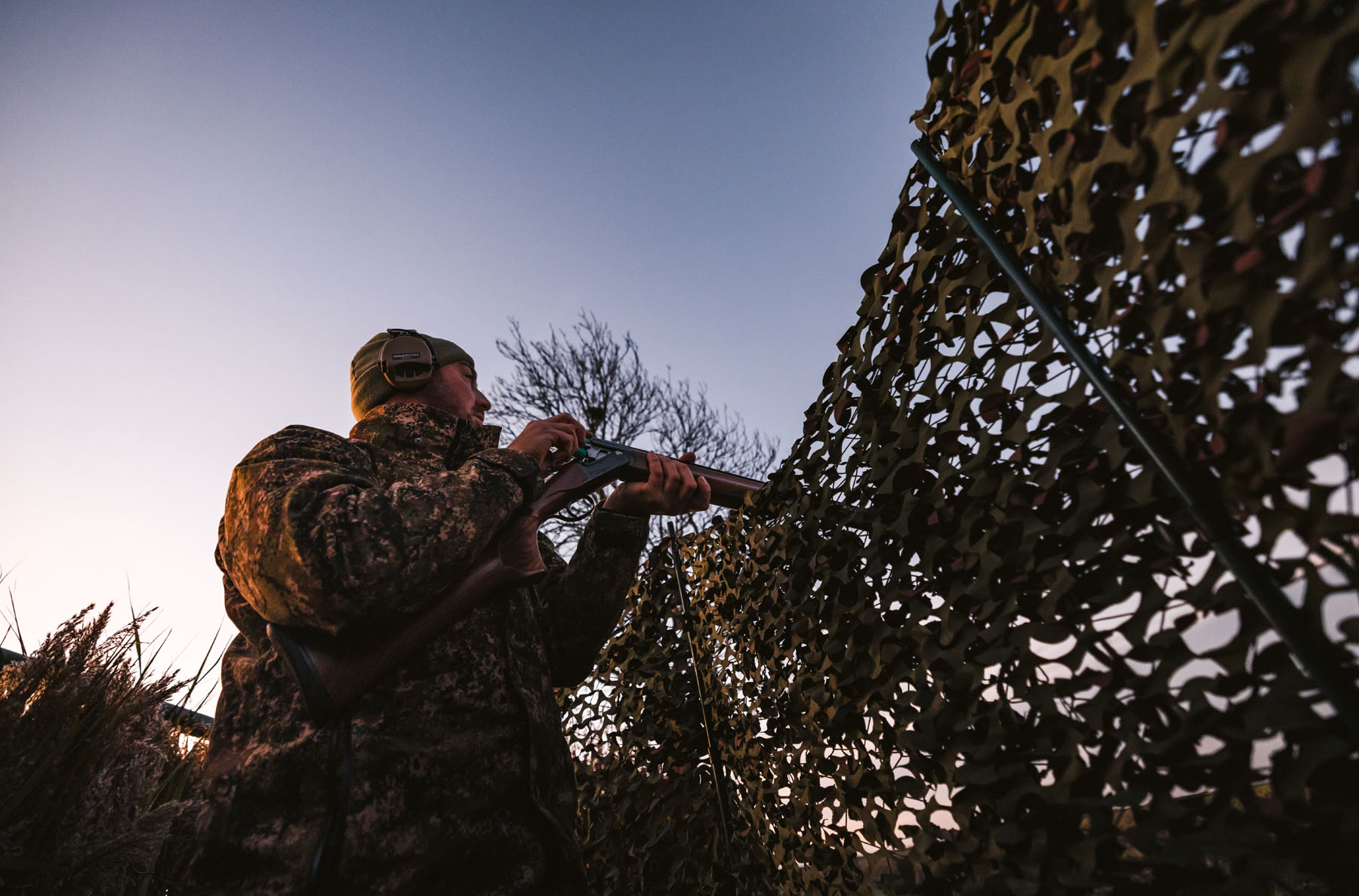
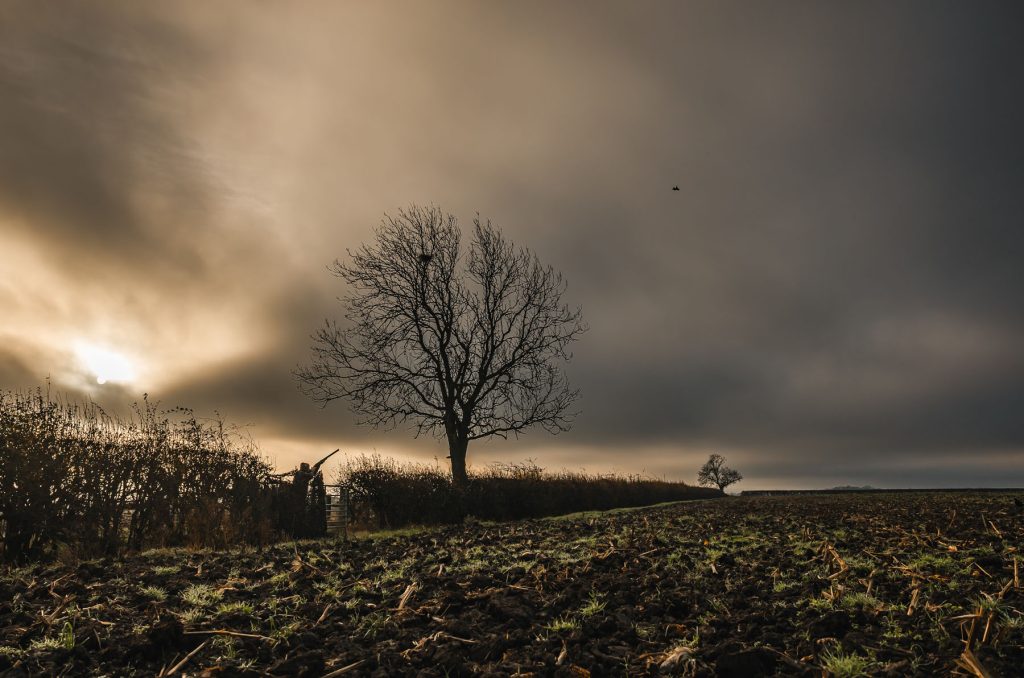
We pulled up beside a steel gate that split a 400m hedgerow of hawthorn and blackthorn. In near-darkness Phil unloaded hide poles, netting, cradles and a whirly. First he added a blind he’d fashioned from rushes earlier in the week to block out the gate, then the poles and netting. Within 10 minutes the hide looked remarkably like a natural extension of the hedge. As Phil returned the truck to the yard, I set up my cameras and remotes. By the time he came back, dawn’s first colours were spilling over the horizon.
“Why aren’t you shooting?” he called, climbing over the gate. I had barely noticed the 100 or so crows circling above. Moments later we were both in the hide. Phil took the first shots of the day – three crows down, two for the whirly and one for a cradle – and the rest scattered.
“It’s not big flocks that make a good morning on crows,” he explained. “It’s steady traffic in ones and twos. I’m not fussed about big bags – what matters is regular pressure. That’s what farmers need.” Over the past week he and a friend had accounted for about 300 crows around the farm.
Fieldcraft tips for successful corvid control and crop protection
He pointed to a tall sittee tree beside us, the highest landmark for some distance. “They use that like a junction point,” he said. “Crows, jackdaws and pigeons follow this hedgerow and keep going, or cross when they hit the tree to that smaller tree out there.” Right on cue, two crows swept past, in range of Phil’s Perazzi. Two more birds for cradles.
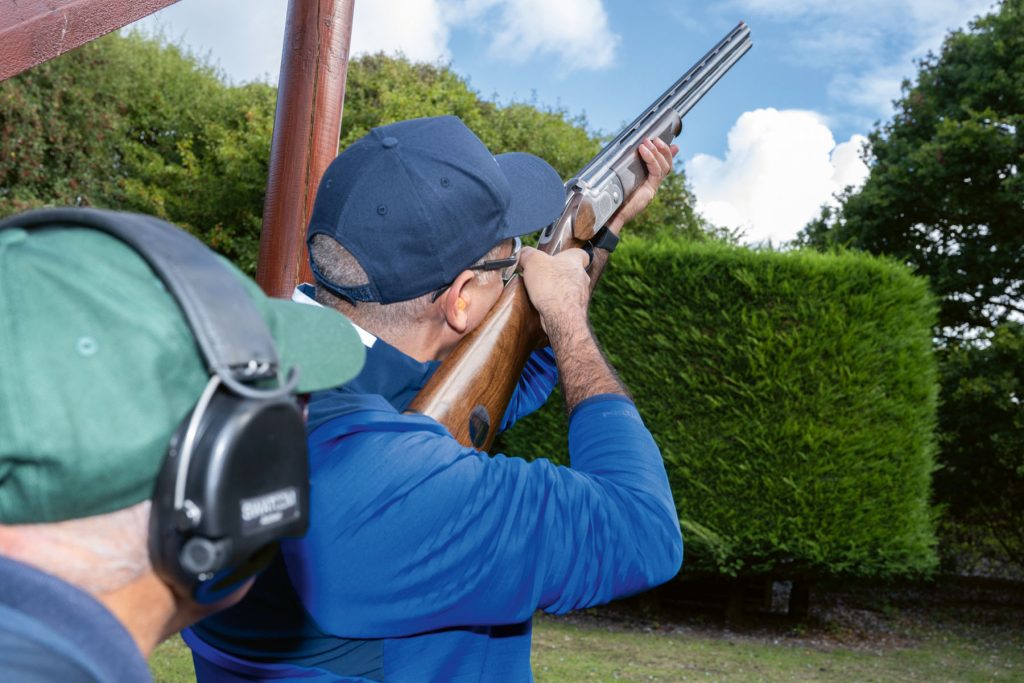
A single bird then came up the hedgeline to our right. “That’s yours,” Phil whispered. I rose and fired both barrels. “Crows often come high and slow, so the hide is higher than normal for pigeons. It makes it harder to judge range through the hide netting,” he said, reassuringly. “You’ve got more time than you think.”
Another chance presented itself directly in front with a low bird steadily making its way up the field. “Have a go at that one,” Phil said. As it approached the pattern, still 50yd away, it climbed dozily, checking its surroundings and sensing that something was off. I stood, missed it with the first barrel but hit it hard with the second. “Good shot. That’s been hit hard in the lungs, but they are hardy birds.” It flew to the other side of the field before dropping.
I was using 32g No 5s, believing them ideal. Phil prefers 34g No 4s. “They hit really hard,” he said. “When you’re protecting crops, meat damage isn’t the concern – clean kills are.”
Best decoys, camouflage and gear for crow shooting
“Crows are immensely clever and their eyesight is ten times sharper than a pigeon’s,” Phil said. “A pigeon races in, but a crow floats, studies everything and if something looks off, it’ll drift away out of range.”
When a trio of high birds flared wide, Phil adjusted the poles higher. “See? They’ve spotted us,” he said. “This is my backup hide – my mate’s got my first-choice kit. The best materials are army surplus, made for hiding tanks. Newer Chinese nets might look great but they can shine in certain light, and that’s no good for crows. It’s the same with plastic decoys. I never use them.”
As the morning aged, more birds appeared. Phil dropped some with astonishing long shots and both of us managed the occasional right-and-left. We had every type of shot. For a man used to competition, it was refreshing to see him enjoy the misses as much as the hits. “If I missed a sitter like that on clays, it’d ruin my day,” he said with a grin. “Out here it doesn’t matter. The satisfaction comes from outwitting wild birds – it’s the same reason I love stalking and wildfowling so much.”
Gaining shooting permission and managing farmland relationships
“Without question the hardest part of crow shooting – and pigeons, foxes and deer, for that matter – is getting permission,” said Phil. “Approach farmers politely and dressed in smart country wear. Take your licence and proof of insurance. Be prepared for rejection.
“Once you’ve got permission, look after it. Don’t leave empty cases, respect the ground and do what you’ve promised. A gift at Christmas goes a long way – whisky or wine and chocolates. It’s something my dad taught me. Once you’ve got one bit of land, more often follows because farmers talk.”
By 11am the sun was high and the crows had quietened. We’d done a solid job for the farmer, accounting for around 40 birds – not a huge tally, but every one counted.
As we packed away the hide and cradles, Phil summed it up perfectly: “You can have all the trophies in the world, but mornings like this are what shooting is really about.” It’s hard to disagree. In the half-light I saw not only a champion shot but a countryman in his element – grounded, capable and quietly doing his bit for the land.
This article contains affiliate links. If you click on one of these links and make a purchase, we may earn a small commission at no additional cost to you. Affiliate income helps us maintain the quality of our content and keep it freely accessible.
All recommendations are based on our honest opinions and thorough research.Would you like to appear on our site? We offer sponsored articles and advertising to put you in front of our readers.
Find out more
Jasper Fellows visits West Kent Shooting School, which stands as one of the UK’s most enduring clay shooting venues. What began in 1974 as a modest setup on a disused RAF airfield has evolved into ...
By Matt Kidd
Get the latest news delivered direct to your door
Subscribe to Sporting Gun
Sporting Gun has been the trusted voice of the shooting community since 1978, and a subscription is the best way to make sure you never miss a word of it.
For just £3.75 an issue – 46% less than the newsstand price – you’ll receive Britain’s leading shooting magazine delivered to your door before it hits the shelves. Every issue is packed with expert gundog training advice, in-depth shotgun and cartridge reviews, technique features from professional shots, pigeon and wildfowling coverage and the people and stories that define the sport.
In a world of endless scrolling, a magazine is something different – a moment to slow down, read properly and absorb knowledge that makes you a better shot. Back issues become a reference library worth keeping.
To provide the best experiences, we use technologies like cookies to store and/or access device information. Consenting to these technologies will allow us to process data such as browsing behavior or unique IDs on this site. Not consenting or withdrawing consent, may adversely affect certain features and functions.
Functional
Always active
The technical storage or access is strictly necessary for the legitimate purpose of enabling the use of a specific service explicitly requested by the subscriber or user, or for the sole purpose of carrying out the transmission of a communication over an electronic communications network.
Preferences
The technical storage or access is necessary for the legitimate purpose of storing preferences that are not requested by the subscriber or user.
Statistics
The technical storage or access that is used exclusively for statistical purposes.The technical storage or access that is used exclusively for anonymous statistical purposes. Without a subpoena, voluntary compliance on the part of your Internet Service Provider, or additional records from a third party, information stored or retrieved for this purpose alone cannot usually be used to identify you.
Marketing
The technical storage or access is required to create user profiles to send advertising, or to track the user on a website or across several websites for similar marketing purposes.