Home/Roost shooting with Geoff Garrod: late-season opportunities
Shooting
Roost shooting with Geoff Garrod: late-season opportunities
Geoff Garrod reflects on a difficult pigeon shooting winter, the challenges of low bird numbers, and a rewarding late roost shooting outing that offers hope for the months ahead
Geoff Garrod2 April 2026
Photography:Richard Faulks
Now the game season has come to a close and I’ve caught up with all of the jobs that entails, it’s time to start looking for pigeons and take a well-earned holiday.
Geoff Garrod on pigeon shooting numbers in the UK
In my last article I wrote about the lack of pigeons in my area. And, as I write now, I’ve not long returned after two days at the Great British Shooting Show at the NEC where I spent time representing the NGO and generally catching up with friends and colleagues.
It was great to see the show so well attended by shooters this year, and it seemed to have a renewed buzz and energy that has been missing. The traders I spoke to were all happy, and I finally got to meet Simon and Selena Barr who are the show’s new organisers.
The topic of pigeon numbers – or lack thereof – came up repeatedly with pigeon decoyers from all around the British Isles who dropped in to see me. So, too, were there many theories discussed as to where the pigeons are at the moment.
My bet remains that they are still enjoying the incredible amount of acorns this winter, which is keeping those that haven’t crossed the channel busy. There’s also still plenty of berries on the ivy and on other trees and hedgerow plants, which has seemed to spread the pigeon population thinly. I just hope that any migratory pigeons that are on the continent make their way back for the spring. It would be very interesting to have some scientific evidence to prove any of these theories – if anybody knows of any research, I’d love to hear from them. For now though, I just have to live in hope and pray for their return.
Why roost shooting remains a key late-season challenge
February is the traditional month for roost shooting, and I love the challenge roosting presents. At home, we usually kick off the roosting period on the first Saturday of February. As a thank you to the shoot’s helpers and beaters, we usually allocate them a wood that they can shoot every Saturday evening until the end of the month.
This year, however, it just wasn’t worth doing as none of us had seen a pigeon in the area for some time. There was one flock of pigeons that arrived in late January, which got me excited, but they soon moved on before the game season finished. So there was much disappointment for a lot of us.
Finding pigeons: decoying vs roost shooting tactics
Since the end of the season, the weather has been horrible too. I travelled to the show in miserable weather, returned in miserable weather, and it hasn’t really stopped raining since. However, with a break in the weather forecast, I decided that I’d have a drive around the estate’s woods to see if I could get a few shots. I packed my gun and one single box of cartridges.
I’d looked around a couple of the most likely woods first, which in a normal year would be full of pigeons at this time. I only saw three of four pigeons across all of them, and I was beginning to think I’d be going home with a full box of cartridges.
Saving the best until last, I continued on to the final suitable wood, which is actually my regular roost shooting wood come February. It is beside a small airfield and overlooks the local town. I was just about to turn off the main road towards it when I spotted some movement on a field of rape through a gap in the hedge.
I pulled-up in the next gateway to have a closer look. There were a few pigeons feeding in the middle of the field, but not enough to get excited about. Anyway, keen to see how many there were, I clapped my hands to scare them off. To my utter amazement, there must have been 200 or 300 hidden amongst the taller rape! Where that number of pigeons had come from I had no idea, and they must have arrived only very recently.
There was no gas gun in the field, but there was one windmill which had been left there for months now. It certainly wasn’t bothering the pigeons as designed. So late in the day, at 3:30pm, there wouldn’t be time enough to set up a hide and decoy them, but it would be worth heading to the wood in hope they would head there to roost once they had finished feeding.
A late-season roost shooting success story
It is a decent-sized wood, with plenty of ivy and firs which pigeons love for shelter. On my arrival past the airfield there were pigeons hanging off the ivy and feeding on the berries all along the roadside. I was starting to think I should have packed more cartridges!
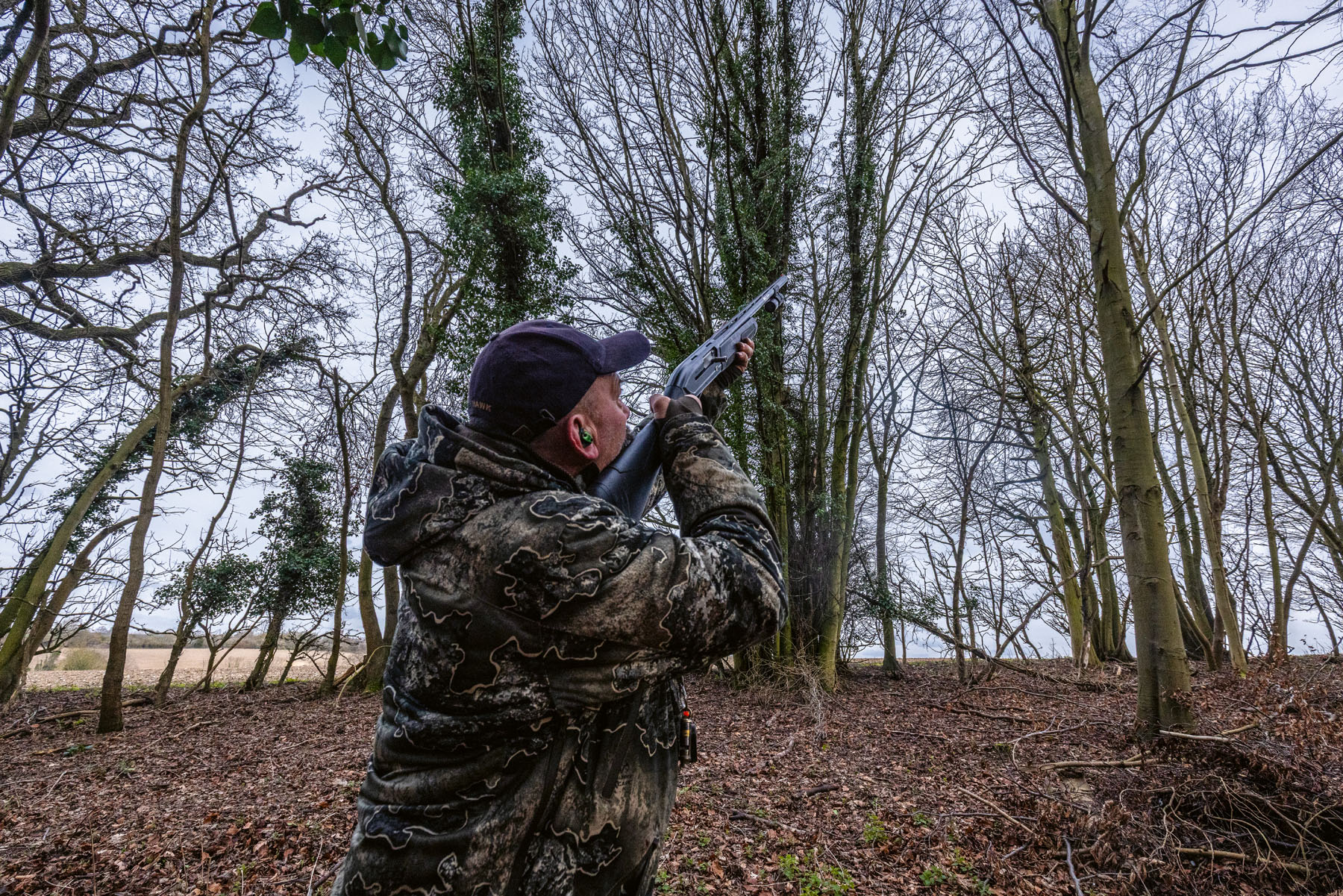
I parked my truck in the wood and walked down towards an area with fir trees, which the pigeons usually seem to like. A few pigeons lifted as I approached, making it clear that some of the newly arrived flock were using the wood to roost. I chose a wide-trunked tree to stand in front of and loaded up the gun.
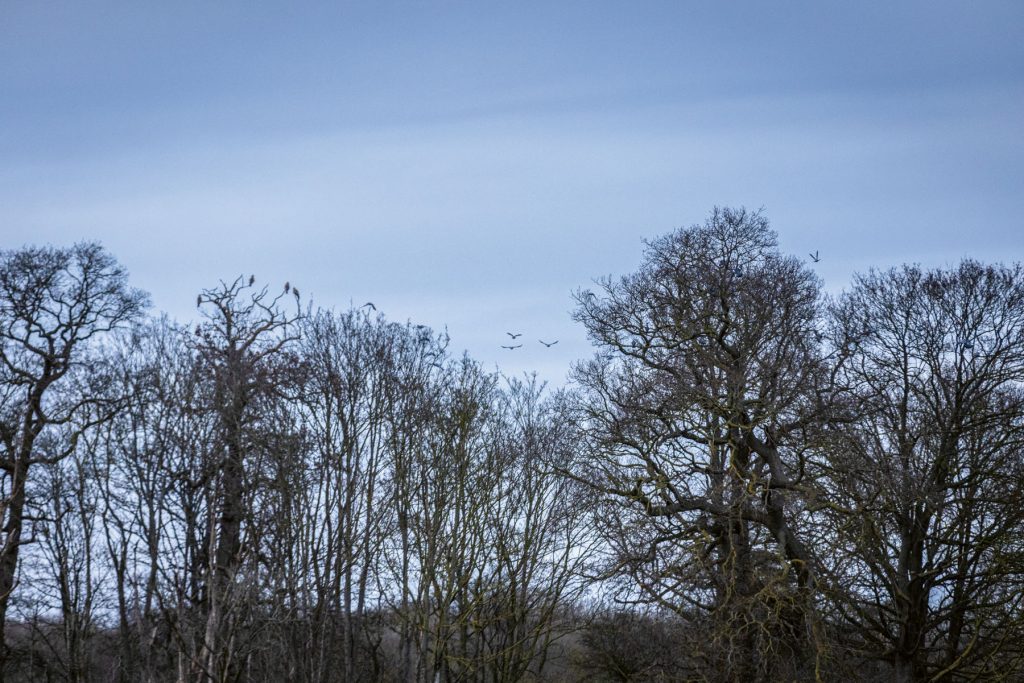
The joy of this particular wood is that if you stand about 5yd into the wood, so long as you have a good backdrop, you have a good chance of spotting pigeons as they fly over the field towards the wood without spooking them. I could see pigeons circling in the field and some of those I’d just disturbed keen to get back into the wood having obviously fed earlier.
One pigeon passed in range over my right shoulder and it crumpled in the air after my shot. A good start – especially as I didn’t really expect to fire any cartridges when I left the house. There were a few more of the recently disturbed birds still circling around over the tree tops and I managed to connect with another couple.
After these initial shots, things went quiet, and I wondered if that was it for the night. Having shot three more pigeons, I was very content – so low were my expectations.
After a little while, luckily for me, I started to see pigeons in ones and twos returning to the wood. Some were coming from the direction of the nearby town, but the majority from the direction of the rape fields. The shooting was steady, challenging and rewarding for the next half an hour, and my decision to only take one box of cartridges out was one I would mildly regret as the pigeons were still coming in as my final shell was fired.
I picked up 12 pigeons and, as expected, their crops were predominantly full of rape when inspected. Some had ivy berries too, but they had been damaging the crop.
What’s next for pigeon shooting this spring?
It was still broad daylight when I got in my truck to head home, which felt very odd as it is usually pitch-black after picking-up on an evenings roost shooting. On the way back, I decided to stop off at another field of rape. Sure enough, there were pigeons feeding there too. A flock of around 100 pigeons took to the air as I beeped my horn, and that is something that has given me a great deal of hope for the coming months.
I’m sure the farm won’t be nearly as happy as I am about this, so they may start getting the gas guns cleaned up for use. It will be interesting to find out what my other decoying friends have experienced, and if the pigeons stay in this area and settle until the spring drilling. Last year, the vast majority of the drilling was completed in the two weeks I was on holiday, but I’m confident that with all the wet weather it won’t be done this year until after I return. If everything falls into place when I return in a couple of weeks, it might turn into a great season. That’s what I’ll be dreaming of on holiday, anyway! The signs are encouraging and my fingers are crossed.
This article contains affiliate links. If you click on one of these links and make a purchase, we may earn a small commission at no additional cost to you. Affiliate income helps us maintain the quality of our content and keep it freely accessible.
All recommendations are based on our honest opinions and thorough research.Would you like to appear on our site? We offer sponsored articles and advertising to put you in front of our readers.
Find out more
Matt Kidd joins Olympic gold medallist Nathan Hales to discover the skills, technique and mental focus required for the holy grail of Trap shooting disciplines
Richard Faulks joins renowned shot and coach John Lee at the Worlaby Shoot to discover how his calm guidance, sharp eye and practical fieldcraft help experienced Guns get the very best from their shoo...
Ben Palfreyman experiences a memorable partridge shoot at Compton Beauchamp, where heritage, hospitality and sporting excellence combine in the heart of West Berkshire
Jasper Fellows visits West Kent Shooting School, which stands as one of the UK’s most enduring clay shooting venues. What began in 1974 as a modest setup on a disused RAF airfield has evolved into ...
By Geoff Garrod
Get the latest news delivered direct to your door
Subscribe to Sporting Gun
Sporting Gun has been the trusted voice of the shooting community since 1978, and a subscription is the best way to make sure you never miss a word of it.
For just £3.75 an issue – 46% less than the newsstand price – you’ll receive Britain’s leading shooting magazine delivered to your door before it hits the shelves. Every issue is packed with expert gundog training advice, in-depth shotgun and cartridge reviews, technique features from professional shots, pigeon and wildfowling coverage and the people and stories that define the sport.
In a world of endless scrolling, a magazine is something different – a moment to slow down, read properly and absorb knowledge that makes you a better shot. Back issues become a reference library worth keeping.
To provide the best experiences, we use technologies like cookies to store and/or access device information. Consenting to these technologies will allow us to process data such as browsing behavior or unique IDs on this site. Not consenting or withdrawing consent, may adversely affect certain features and functions.
Functional
Always active
The technical storage or access is strictly necessary for the legitimate purpose of enabling the use of a specific service explicitly requested by the subscriber or user, or for the sole purpose of carrying out the transmission of a communication over an electronic communications network.
Preferences
The technical storage or access is necessary for the legitimate purpose of storing preferences that are not requested by the subscriber or user.
Statistics
The technical storage or access that is used exclusively for statistical purposes.The technical storage or access that is used exclusively for anonymous statistical purposes. Without a subpoena, voluntary compliance on the part of your Internet Service Provider, or additional records from a third party, information stored or retrieved for this purpose alone cannot usually be used to identify you.
Marketing
The technical storage or access is required to create user profiles to send advertising, or to track the user on a website or across several websites for similar marketing purposes.