Home/Olympic trap shooting with Nathan Hales: a masterclass in technique and performance
Shooting
Olympic trap shooting with Nathan Hales: a masterclass in technique and performance
Matt Kidd joins Olympic gold medallist Nathan Hales to discover the skills, technique and mental focus required for the holy grail of Trap shooting disciplines
Matt Kidd12 May 2026
There are few more authoritative guides to Olympic Trap than Nathan Hales. Olympic gold medallist, record holder and one of the most technically gifted Trap shots in the world, he is also full of practical detail – the sort that makes a difficult discipline begin to make sense.
I joined him at Nuthampstead Shooting Ground on its Olympic Trap layout, which Nathan rates as the best around. It is also a venue woven into his own story: after only two years in the discipline, he became the first person ever to shoot 100-straight there. With its green-sheet backdrop and international-standard presentation – the kind seen at major championships, including Paris – it is easy to understand why he thinks so highly of it.
Jumping straight in, we started with a round. I had never shot Olympic Trap before and managed a respectable enough 16/25, slightly higher than Nathan predicted. After which Nathan offered a few pointers, then fitted his Beretta SL2 with a spare right-handed stock for me to use on some condensed rounds – immediately hitting targets more consistently. That alone raised some interesting questions.
What followed was a fascinating lesson in the technical, mental and practical demands of Olympic trap shooting, and in why the very best make it look simpler than it is.
The trap disciplines explained in Olympic trap shooting
Nathan sees Trap as a progression, with each discipline building on the one before it. “At the more accessible end,” explains Nathan, “is down-the-line, where one trap oscillates left to right at a fixed height.”
From there comes ABT or Ball Trap, which introduces more variation. “It is still a single-Trap discipline,” he adds, “but one that moves left to right and up and down, making it less predictable and a little more demanding.
“Universal Trench is the next step on, using the centre five traps of an Olympic layout.” Each trap is fixed for height and angle according to the scheme in use, and the shooter works across all five stands. Even there, Nathan points out, some targets can be awkward, especially when a hard angle cuts aggressively across the shooter.
“Then comes Olympic Trap, which is the holy grail of the Trap disciplines,” he smiles.
What makes Olympic trap shooting different
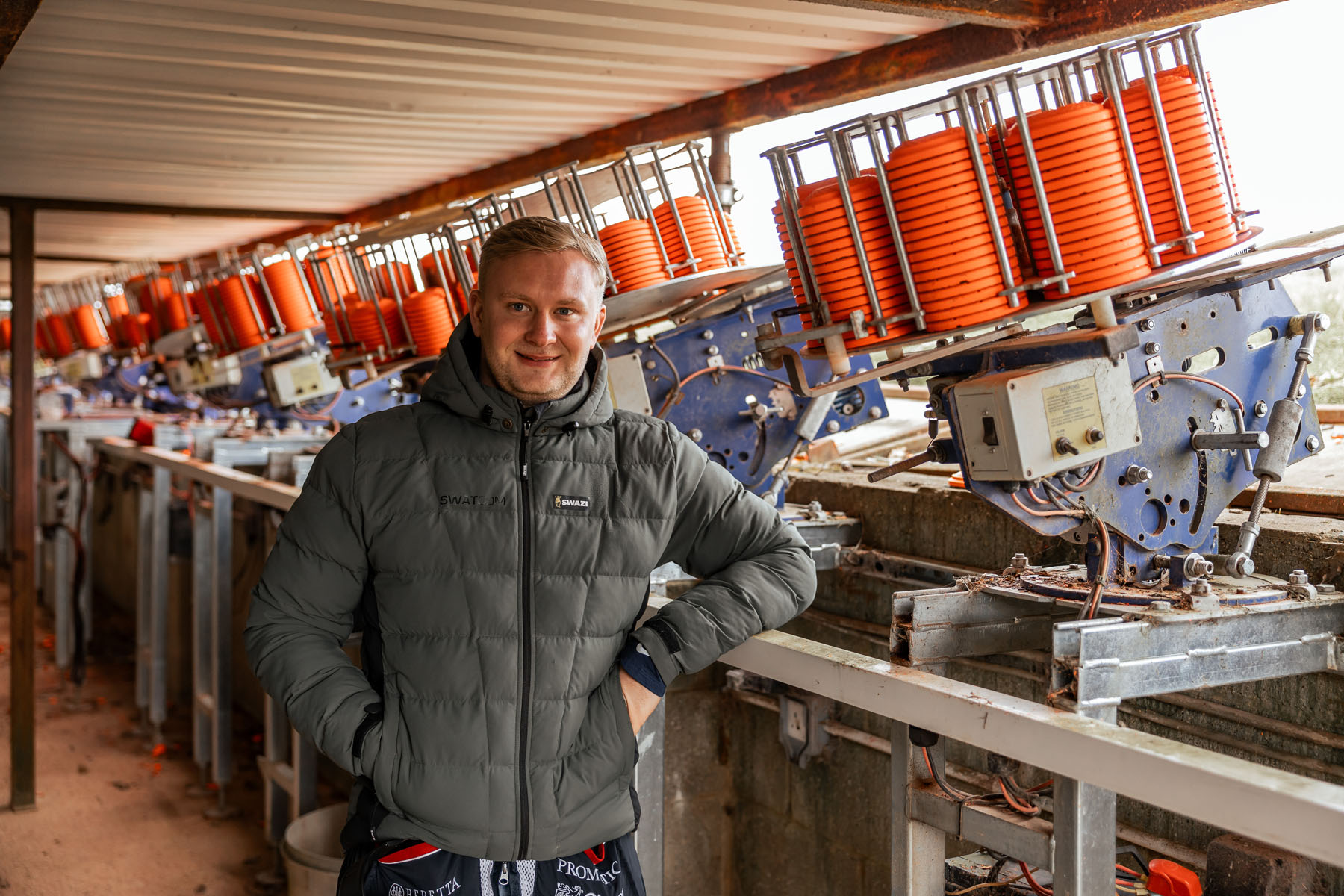
“Olympic Trap is different in scale, speed and complexity,” as Nathan explained, taking us down the range to look at the trench enclosing the traps. “Rather than one trap or five, there are 15 in the trench. Each peg has three traps, one throwing a clay left, one straight, and one to the right.
“The tolerance for how far a clay is thrown is really strict, with each landing at 76m, give or take 1m. The hight variance is also very structured, which is measured at 10m from the trap, and is only allowed to be between 1.5m and 3m.”
Nathan explains that the layout runs to a number of pre-set schemes, each determining the height and angle of the targets from each peg. This giving the discipline its structure, while still keeping the shooter under constant pressure.
Each peg is measured 16m behind the trench, with a marker – a white clay at Nuthamstead – over each of the five centre traps. “This marker is a great reference to establish your ideal hold point.”
As for break distance, top shooters are not hanging around. Nathan says a typical first shot may be taken at around 27-28m, with the second likely to be around 33-34m if required.
Routine before the shot in Olympic trap shooting
What stands out when watching Nathan shoot is not speed, but order. Everything is done the same way, every time.
His process begins the moment he steps onto the peg. Because the gun cannot be loaded before stepping on, he follows the same sequence with the cartridges, the same foot adjustment, the same visual checks.
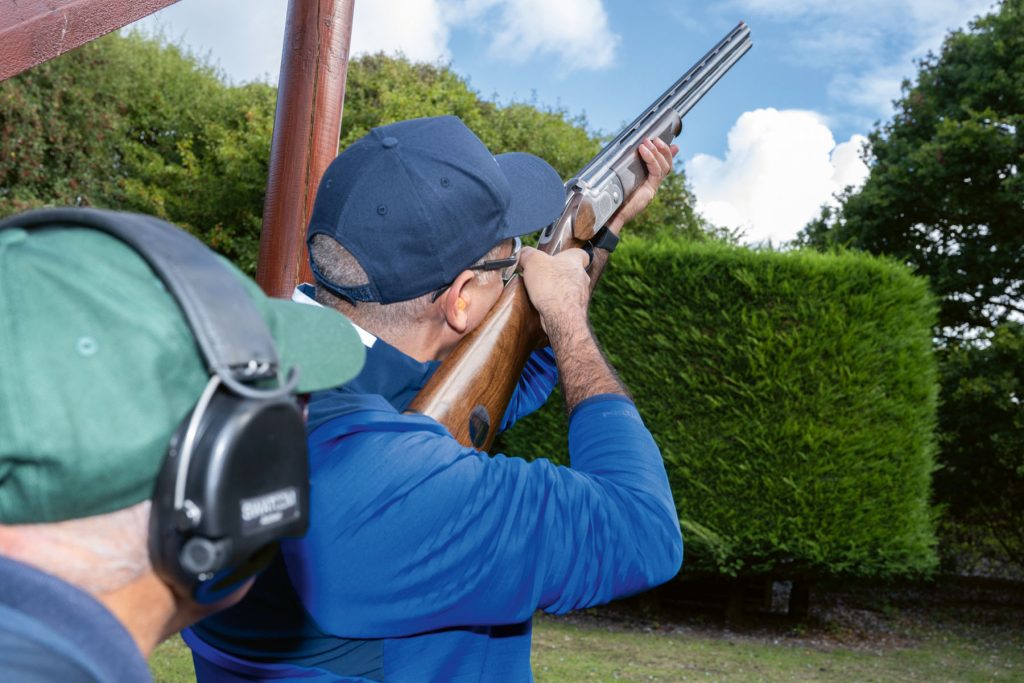
Only when the shooter before him fires does he shift fully into focus mode. “I do a deep breath in and out through the nose,” he says. “I then lift my gun into the sky first when mounting, to help make sure my shoulders are level, then drop my muzzles down into the hold point. Typically not on the peg marker, but just above it.”
It is a routine built to remove clutter. By the time he calls, he is settled, balanced and visually ready.
Grunt vs calling pull in Olympic trap shooting
One of the more striking details of Nathan’s process is that he does not sharply call “pull” in the conventional way. Instead, he uses a quieter grunt-like release.
“There is logic behind it. Actually saying a word requires you to use your jaw,” he explains, “which forces your head to move on the stock a little. In a discipline this fast, even that slight movement matters.”
There is also the microphone to consider. Nathan notes that the system can be inconsistent depending on sensitivity, and that a spoken word may not trigger the release exactly when intended. “Shouting ‘PULL’, the microphone might not register the ‘pu’ part, but only the ‘ll’, so a shorter, simpler vocal cue reduces that risk and keeps the timing more repeatable.”
It is a small point, but Olympic trap shooting is full of small points. Stack enough of them together and they become the difference between success or failure.
Managing a full round of Olympic trap shooting
Nathan is realistic about concentration. He does not believe anyone can maintain perfect focus throughout an entire round without pause.
Instead, he works in bursts. When on the peg, he is fully engaged in his routine and shot process. If something has gone wrong, he addresses it there. But once he steps away from the peg he leaves it behind.
Between turns, he avoids forcing concentration. He remains aware, but not mentally overactive. Then, when the shooter before him fires, he uses his breathing to lock back in.
That ability to reset matters hugely. Olympic trap shooting is too quick and too unforgiving to carry irritation from one target to the next. The discipline is as much about emotional control as technical execution.
First barrel then second in Olympic trap shooting
“The ambition, of course, is always to kill with the first barrel. At elite level, that matters enormously,” he says, with qualification scores built on as many first barrels as possible.
When Nathan did rarely miss the first target, the second shot was amazingly instantaneous. For me, there was a lag, and rarely was it successful. “A second barrel has to be immediate when it is needed. Ideally, if the first shot has missed, it is because you pulled the trigger too early, so your gun simply keeps moving on the line with the second shot arriving at the right time. The second shot is not reassembling the picture from scratch; but trusting the movement already in progress.”
Tips for newcomers to Olympic trap shooting
Nathan was kind about my first attempt, but clear-eyed too. The easiest improvements would not come from heroics at the target, but from tidying the basics.
“If you get your foundations right to start with,” he says, “that’s the easiest thing to get right.” By that he means body position, foot position and weight distribution – all the things that shape the move before the target has even appeared.
My hold point had also started low, underneath the marker. Nathan wanted the gun just above it, with the eyes looking a touch further out into the area rather than being pinned too tightly to the muzzles.
Interestingly, he says many newcomers make the opposite mistake and hold too high, allowing them to move the barrels to the left or right, and already covering the centre. “That can feel simpler at first, but it usually forces the shooter to wait too long before moving, and timing starts to unravel from there.”
Once the clay was in the air, my issues were of efficiency. Like many first-timers, I was too careful. My first shot would be further out than Nathan would shoot them, and if I missed, I would watch the target and try to shoot it way too far out. It worked a couple times, but nothing more than a fluke.
Why the Beretta SL2 suits Olympic trap shooting
Nathan wasn’t surprised that I shot better with his Beretta SL2. “It’s a dedicated set-up for trap,” he says, and that matters. “Your Browning is a Sporting gun, which is flatter shooting and therefore less naturally suited to a pre-mounted Trap discipline where targets are generally taken on the rise.”
A Trap gun, by contrast, tends to have stock dimensions that sit the gun a little higher, sometimes with less drop and a different grip shape. In short, it presents a more helpful picture for this specific job. It does not make the sport easy, but it certainly explains why the SL2 felt more natural and more forgiving.
Why the right target is harder in Olympic trap shooting
I struggled more with the right target than those heading left, and Nathan’s explanation came back to body position.
“As a right-handed shooter, you have too much weight sitting on the heel of the front foot, which makes it difficult to rotate cleanly towards the line, instead forcing your swing to arc under the target. From there you are then having to recover the line which makes the target a longer way out than ideal, and any chance of hitting anything just a matter of hope.”
The lesson was obvious enough: Olympic trap shooting punishes any inefficiency immediately.
Why straight targets deceive in Olympic trap shooting
The straight going-away target felt, to me, strangely awkward. Nathan says that is common.
There are two typical errors. The first is to attack it far too quickly because it appears right where the gun and eyes are already holding. The second is the opposite – trying to over-confirm it and, in doing so, losing all gun speed.
In other words, the easiest-looking target can become the one that exposes indecision fastest. Straight does not always mean simple.
Training tips to improve Olympic trap shooting performance
For the average shooter trying to become good, Nathan believes the first task is to establish sound fundamentals and then isolate target types. “That means repeated lefts, repeated rights and repeated straights, building movement patterns rather than obsessing over score. Only once those foundations are settled does high volume really become valuable.”
To go from good to great, the emphasis shifts to first-barrel excellence. Nathan believes top Trap shooters need a very high proportion of first-shot kills, and that means training with greater precision.
“Single-barrel work becomes especially important,” he adds, “as it exposes technical weakness immediately and sharpens discipline. Sometimes I will shoot comps with only one cartridge, reinforcing the need to get that first shot absolutely spot on.”
He also believes in pressure. Sometimes that comes through competition; sometimes through score-based training drills or even small bets with a coach. Whatever the method, the principle is the same: learn to reproduce good movement when the shot matters.
Watching Nathan explain Olympic trap shooting, and then watching him shoot it, the discipline begins to look a little less mysterious. Not easier, exactly – but clearer. In his hands, it is a sport of order, timing and relentless refinement, where every detail matters.
This article contains affiliate links. If you click on one of these links and make a purchase, we may earn a small commission at no additional cost to you. Affiliate income helps us maintain the quality of our content and keep it freely accessible.
All recommendations are based on our honest opinions and thorough research.Would you like to appear on our site? We offer sponsored articles and advertising to put you in front of our readers.
Find out more
Richard Faulks joins renowned shot and coach John Lee at the Worlaby Shoot to discover how his calm guidance, sharp eye and practical fieldcraft help experienced Guns get the very best from their shoo...
Ben Palfreyman experiences a memorable partridge shoot at Compton Beauchamp, where heritage, hospitality and sporting excellence combine in the heart of West Berkshire
Geoff Garrod reflects on a difficult pigeon shooting winter, the challenges of low bird numbers, and a rewarding late roost shooting outing that offers hope for the months ahead
Jasper Fellows visits West Kent Shooting School, which stands as one of the UK’s most enduring clay shooting venues. What began in 1974 as a modest setup on a disused RAF airfield has evolved into ...
By Matt Kidd
Get the latest news delivered direct to your door
Subscribe to Sporting Gun
Sporting Gun has been the trusted voice of the shooting community since 1978, and a subscription is the best way to make sure you never miss a word of it.
For just £3.75 an issue – 46% less than the newsstand price – you’ll receive Britain’s leading shooting magazine delivered to your door before it hits the shelves. Every issue is packed with expert gundog training advice, in-depth shotgun and cartridge reviews, technique features from professional shots, pigeon and wildfowling coverage and the people and stories that define the sport.
In a world of endless scrolling, a magazine is something different – a moment to slow down, read properly and absorb knowledge that makes you a better shot. Back issues become a reference library worth keeping.
To provide the best experiences, we use technologies like cookies to store and/or access device information. Consenting to these technologies will allow us to process data such as browsing behavior or unique IDs on this site. Not consenting or withdrawing consent, may adversely affect certain features and functions.
Functional
Always active
The technical storage or access is strictly necessary for the legitimate purpose of enabling the use of a specific service explicitly requested by the subscriber or user, or for the sole purpose of carrying out the transmission of a communication over an electronic communications network.
Preferences
The technical storage or access is necessary for the legitimate purpose of storing preferences that are not requested by the subscriber or user.
Statistics
The technical storage or access that is used exclusively for statistical purposes.The technical storage or access that is used exclusively for anonymous statistical purposes. Without a subpoena, voluntary compliance on the part of your Internet Service Provider, or additional records from a third party, information stored or retrieved for this purpose alone cannot usually be used to identify you.
Marketing
The technical storage or access is required to create user profiles to send advertising, or to track the user on a website or across several websites for similar marketing purposes.